Home coffee · Consumer · Live · 4 min read
Espresso Machine Advisor
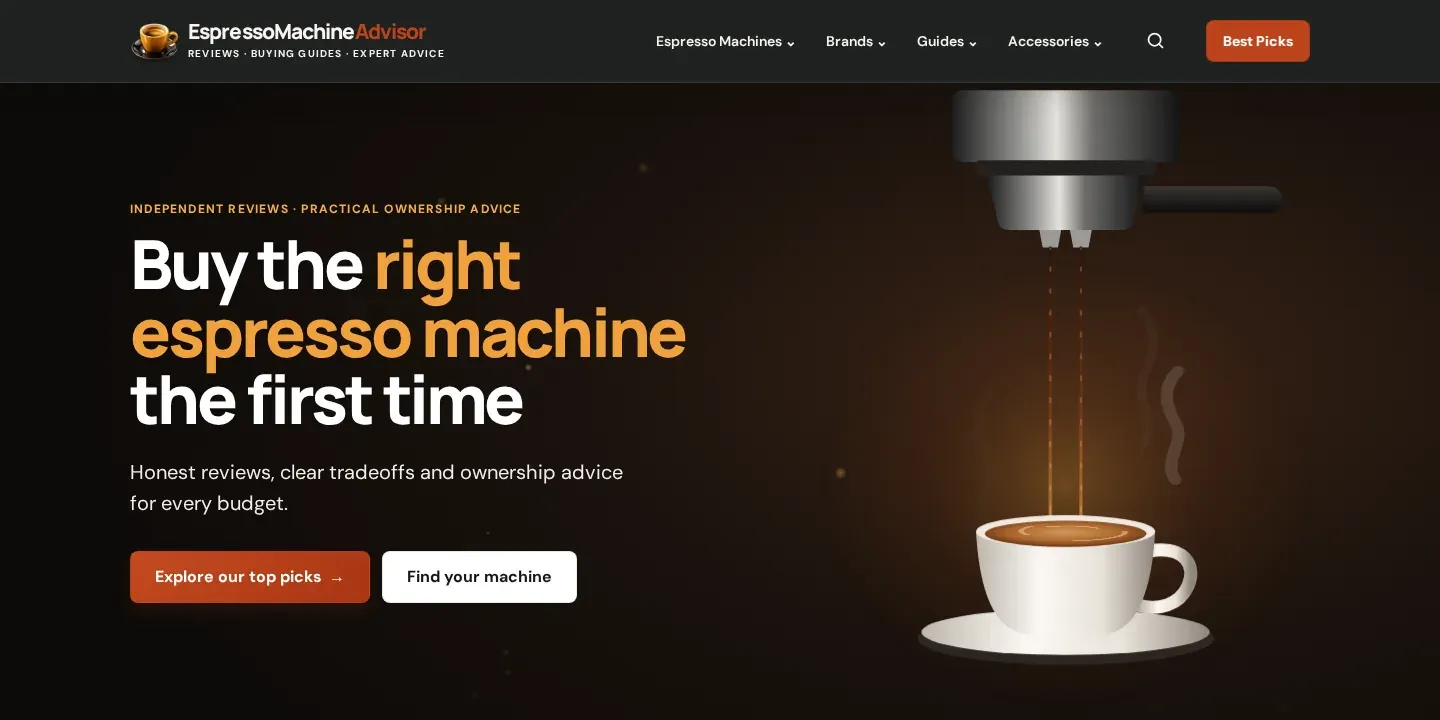
An independent buying guide for US home espresso buyers, with reviews, comparisons and a four-question machine finder
- Live product
- Visit product
- Product team
- LucidReactor Labs
- Our contribution
- Content strategy
- Editorial rules
- Machine finder
- Affiliate routing
- Click tracking
- SEO
- Technologies used
- Astro
- TypeScript
- Cloudflare Pages
- Cloudflare D1
- Motion
The Challenge
Most home espresso buyers plan to spend between about $150 and $3,000. The wrong choice is expensive, and the problem often appears only after months of daily use.
The buyer must compare very different machines. A superautomatic makes a latte at the press of a button. A manual lever machine depends on the skill of the person who uses it. Specifications alone do not show which machine fits a real kitchen and a real morning.
Buyers ask the same questions again and again:
- Do we need one-touch milk drinks, or do we want to make them by hand?
- How much time will we spend on the machine each day?
- What is the full budget, including a grinder?
- Will the machine fit under our kitchen cabinets?
A list of “best” machines does not answer these questions. A buyer also needs to know who should not buy each machine, and what ownership costs in time and money.
Our Role
LucidReactor Labs planned, designed and built Espresso Machine Advisor. Our work covered:
- Content structure for reviews, best-of pages, brands, comparisons and ownership guides
- Editorial rules for sources, specifications, prices and honest language
- UX and build of the four-question machine finder
- A central table for every product link
- First-party tracking of finder use and product clicks
- A script that checks every content page
What We Built
Honest research rules
We set one rule first: the site does not claim hands-on testing. Recommendations come from manufacturer specifications and manuals, published measurements and long-term owner reports. The About page says this clearly.
We added more rules around this one. If we cannot confirm a specification, we leave it out. We give price bands, not exact prices, because prices change often. Every review also names the buyer that the machine is wrong for.
A machine finder
The finder asks four questions: drinks, daily effort, budget and counter space. It then asks for a name, an email address and a ZIP code, and shows one match and one runner-up.
Each result must connect to a published review, a product image and a product link. If one of these is missing, the build stops. A buyer cannot get a result that leads to a dead end.
One table for product links
Pages do not link to Amazon directly. Each link goes through a short /goto/ address that reads from one central table. We can change a product listing in one place, and every page uses the change. If a product goes out of stock, the link goes to a page on the site.
The site discloses its Amazon Associates income in the footer, on review pages and in the privacy policy.
First-party measurement
A small Cloudflare D1 database records finder runs and product clicks. An anonymous visitor ID and a run ID connect each finder answer to the click that follows it. This shows which matches lead to a product click, and where each click started.
A content check script
A script checks each content page against the editorial rules. It checks page length, internal links, link limits and external links in the built site. It also fails on overused phrases, and on any claim of hands-on testing.
The Result
Espresso Machine Advisor is live. Figures at the time of initial deployment:
- 54 pages in the sitemap
- 13 machine reviews
- 9 best-of pages, for machine types, budgets and small kitchens
- 56 products in the central link table
- 4 questions to get a machine match
A buyer can now go from a broad question to one match and a clear runner-up, with the reasoning and the tradeoffs on the page.
Key Takeaways
State the limits of your research. A site that does not test machines can still be useful, if it shows where each fact comes from.
Say who should not buy. A buying guide earns trust when it names the wrong buyer, as well as the right one.
Put the rules into code. A script applies a rule to every page, so the rule does not depend on memory.
Questions
Frequently asked
What is Espresso Machine Advisor?
An independent buying guide for US home espresso buyers. It has machine reviews, comparisons, brand overviews, ownership guides and a four-question machine finder.
How does Espresso Machine Advisor research machines?
It uses manufacturer specifications and manuals, published measurements and long-term owner reports. The site does not test machines in a lab, and it says so.
How does the site earn money?
Through the Amazon Associates program. Product links go through a short link on the site, and the site discloses this. No brand pays for a place on its lists.
What did LucidReactor Labs build?
The content structure and editorial rules, the machine finder, a central table for product links, first-party click tracking and a script that checks each content page.
Want something like this built?
We design and build focused software, from idea to launch. Tell us about your project.